
Everything a Google Search Reveals About Your Therapist
On self-disclosure, the craft of peer support, and building something clinicians can't be

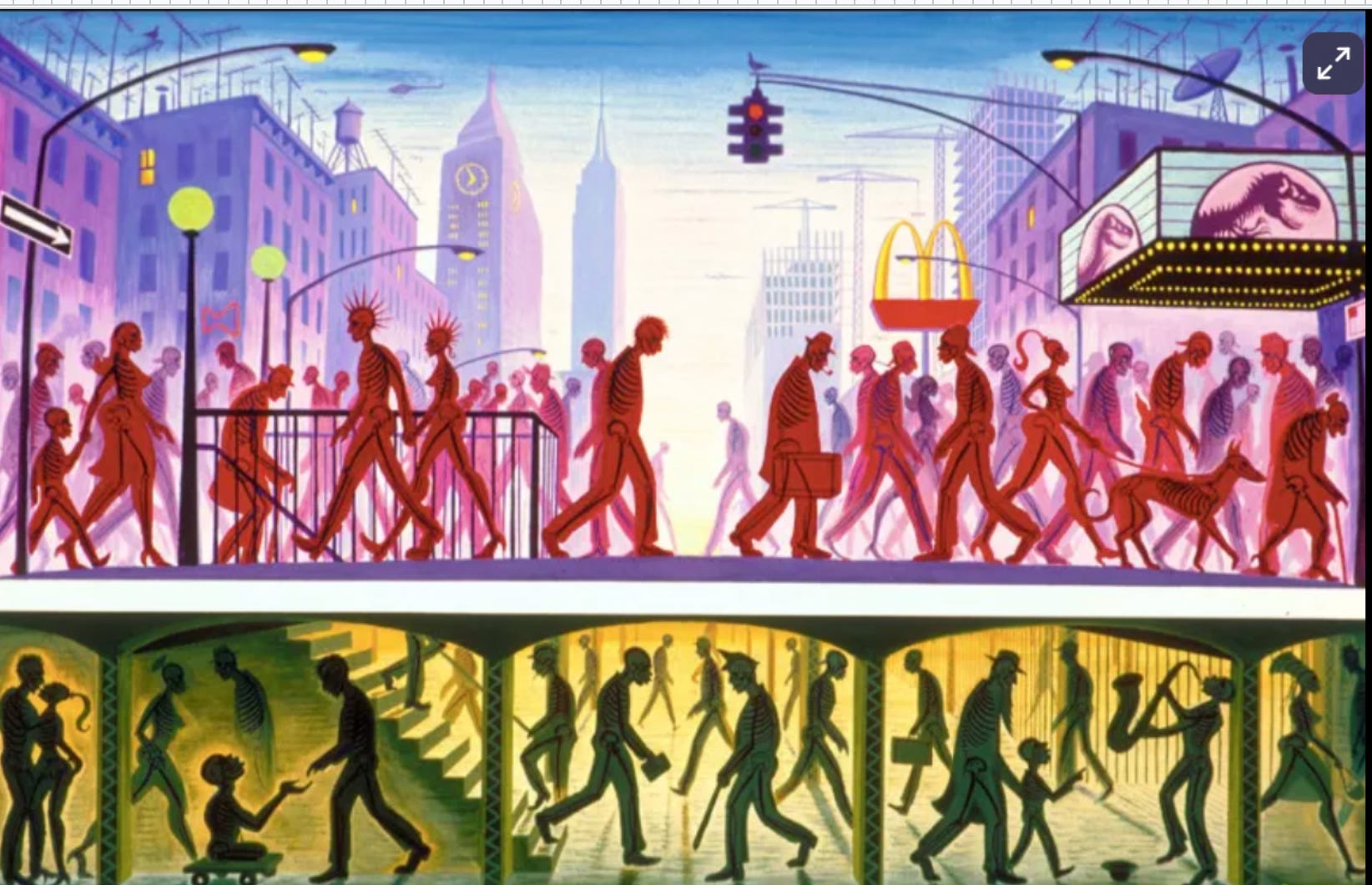
spectacular art by drooker.com
What makes you feel comfortable when you’re talking to a stranger?
How about when the stranger is a potential new therapist?
I think of myself as a friendly and open person, but when I’m sizing up someone I might work with as a therapist, my sharp protectors show up at my side, carrying reminders of old trauma, and I find myself speaking for them.
What I’m listening for in those first encounters is the person’s realness, which I assess with the tuning fork of my own. Does this person seem comfortable in themselves, faults included? How much have they wrestled with their own shadow, and did any friendship come out of the fight? Can they speak for their parts that have suffered? Do they acknowledge their own suffering at all, or are they too professional to be caught being vulnerable? Can they let me know, skillfully, that they understand the limits of what a therapist can be?
That’s what I’m weighing when I decide whether I’ll be able to be honest with someone I’m paying to talk to me.
So I was struck by a recent Substack post from the Jungian analyst Lisa Marchiano, in which she takes aim at young therapists who share personal information about their lives online to attract clients. She sees a profession losing its boundaries. I see something else going on, and I have a stake in the question: I've spent six years building a practice that looks a lot like therapy, without a license, in the open. I know there's an absurd cornucopia of grifters out there, wellness coaches and life optimizers and worse, and on the surface it can be hard to tell who's legit. Stick with me. By the end I hope to convince you that the answer to that problem isn't fewer people like me. It's more.
The Argument
The first time I ventured through the door of a psychotherapist’s office, I was 22. My therapist was a middle-aged woman with glasses and fine, straight hair. She wore bulky sweaters and sensible shoes. I knew she was married because she wore a wedding ring, but that was all I knew. She said very little, revealing almost nothing about her thoughts as I prattled on, but I experienced her as a steady presence companioning me while I navigated the confusion of young adult angst.
In contrast, she notes:
In recent years – with the advent of social media – new norms have taken hold in the business of therapy. On Instagram and other social media sites, therapists now routinely reveal their own histories of substance abuse, trauma, and mental health struggles. They may divulge details about their sexual preferences and political beliefs. They make “relatable” content that features videos of themselves dancing, enjoying a glass of wine, or talking about their life from their car.
I would definitely fall into the category of one of the therapists she’s describing. Anyone who reaches out to me for a consultation already knows that I’m diagnosed with bipolar disorder and that I spent many years publicly organizing, using my stories of institutionalization and collective empowerment to build a movement to transform society’s understanding of mental illness. For those of us diagnosed with 'serious mental illness,' therapy is often fraught, shaped more by the DSM and fears of legal liability than by genuine human compassion. It’s why people seek me out. It’s why exhausted parents want me to talk to their suffering children. After the circus of diagnosis and drugs and hospitalization, it can be very hard to trust a therapist who hasn't been through some version of it themselves.
It might very well be that Marchiano and I are using the word “therapy” to talk about different things. The people who find my practice have usually been through some pretty rough times, not just the “confusion of young adult angst” but rather the confusion of getting diagnosed with a psychotic disorder and of coming home from the hospital to a family that's often terrified of them. From where I stand it’s hard to imagine how speaking to a stranger who purposely conceals their inner world would result in genuine connection and healing.
On Power Dynamics and Realness
When we started the Icarus Project, so many of us had been left feeling pigeonholed and unseen by the mental health system that the whole point of our peer support groups was to create spaces without those power dynamics. But I never stopped being curious about the craft itself. Over the decades I studied therapy models formally and informally, from somatics to depth psychology to family systems, and when I finally went to social work school in my late 30s, I assumed I'd get licensed and become the therapist I'd never been able to find. I entered my MSW program looking for the legitimacy I couldn't find in radical peer support.
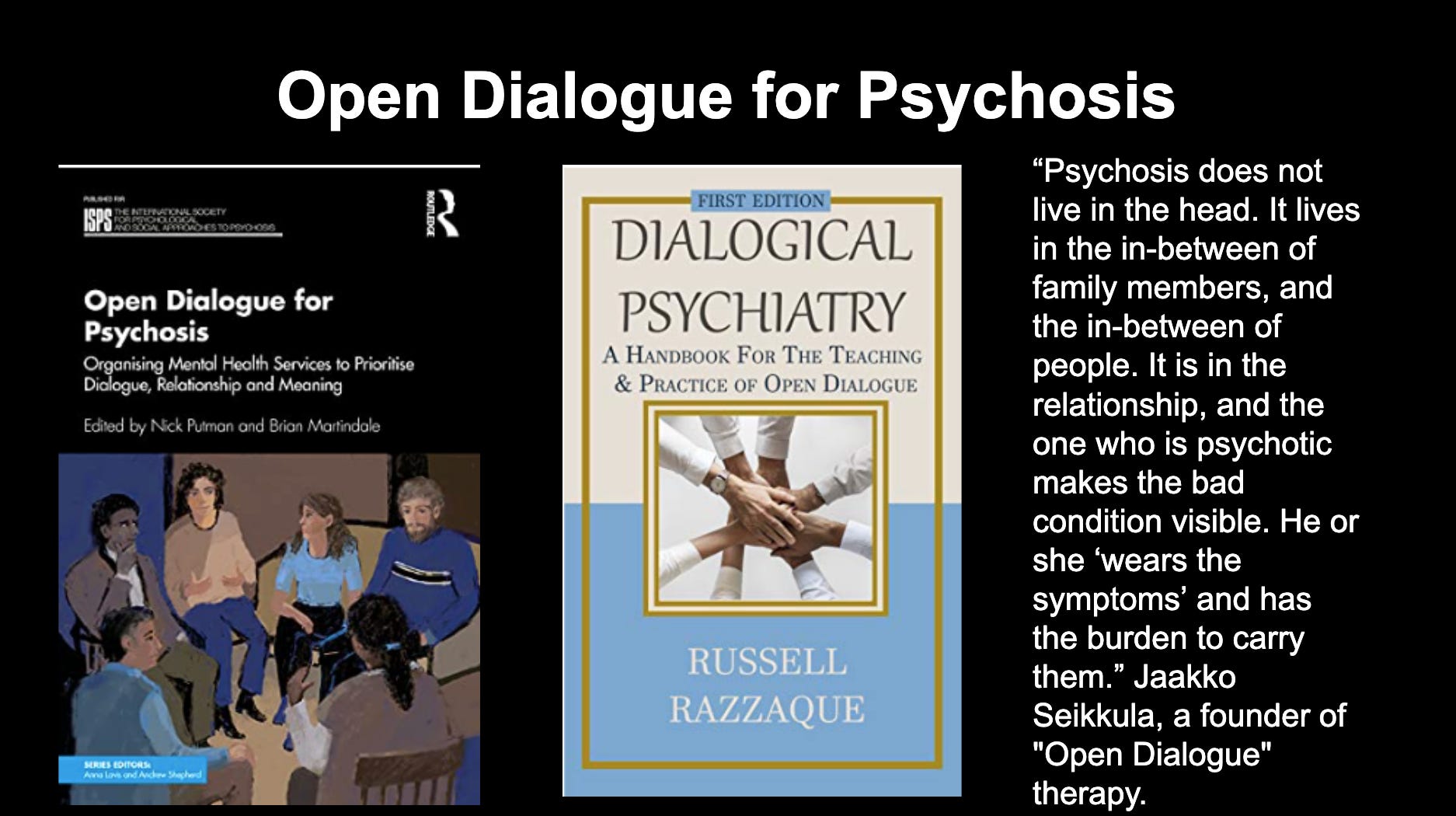
A twist of fate sent me elsewhere. My clinical internship was with Parachute NYC, an experimental program where clinicians worked side by side with peer support workers: people like me, diagnosed with mental illness, hired to use their lived experience in non-clinical ways. It was a role my own movement had fought for, and here it was, embedded in the system. Our teams facilitated Open Dialogue meetings for families whose loved one had just come out of the hospital, and I took to the work naturally. But I kept wondering: was I a "peer" or a "clinician"? I understood the theory as well as anyone on the team, but what actually opened up the rooms we sat in was my willingness to share from my own life, something I'd had years of practice at.
Straight out of grad school I got a job at the New York State Psychiatric Institute, developing the peer support role for First Episode Psychosis teams across the country. Three years inside that work taught me two hard lessons.
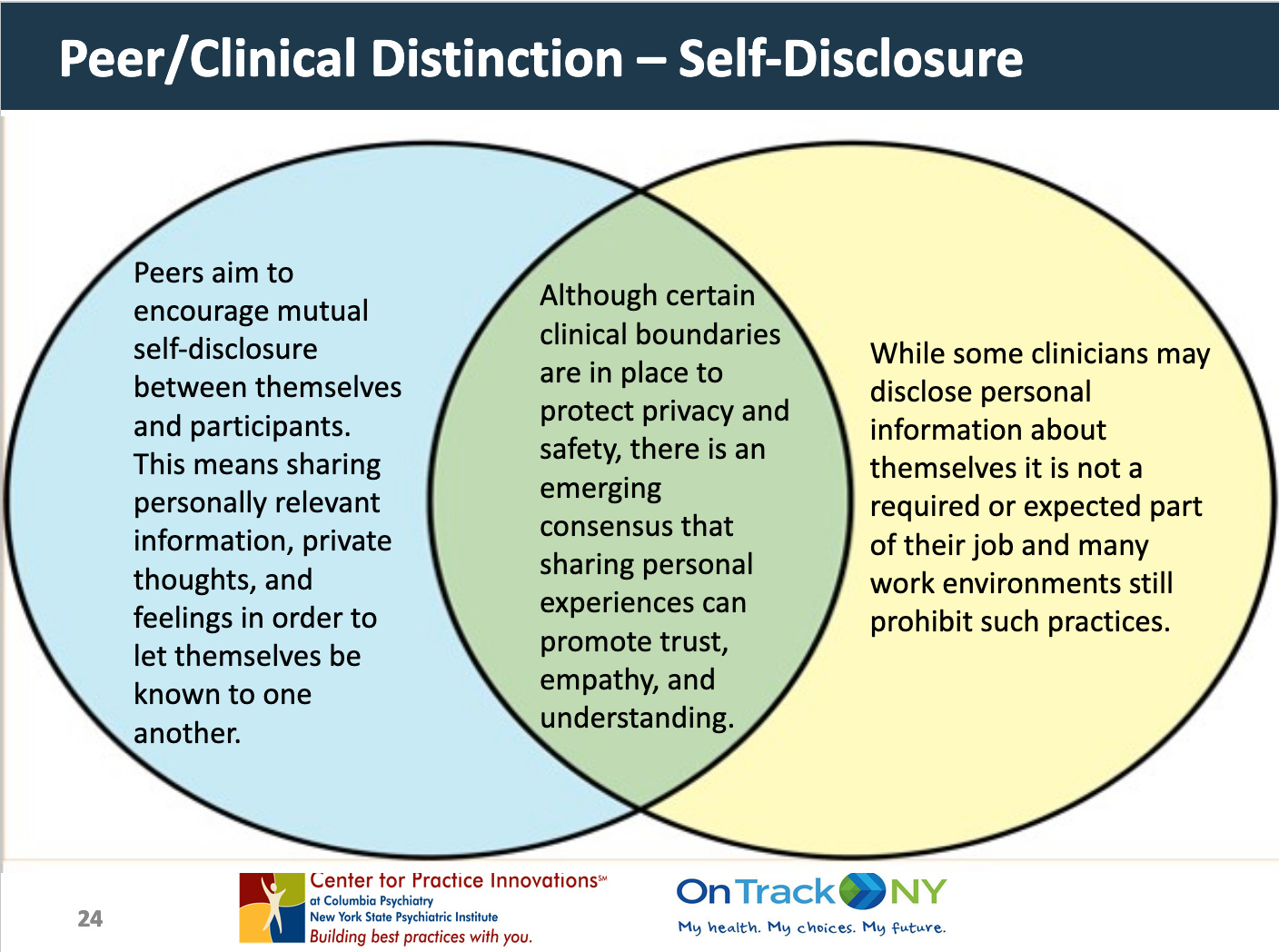
(One of numerous slides I made to train the distinction between peers and clinicians.)
The first was about clinicians. The basic architecture of the role makes genuine relationship hard, and the biggest obstacle is assessment: clinicians are trained to look at a young person and see their pathology, and it is very hard to be a real human with someone you’re busy clinically assessing. When it came down to it, I didn’t believe the diagnoses were all that relevant to treatment anyway. They mattered for the research protocols and the billing. That was about it.
The second was about peers. The role didn’t have the institutional weight to be genuinely empowering. Peers were paid far less than everyone else on their teams and often ended up doing the same paperwork as the clinicians, a cheap, less credentialed labor force pitted against the colleagues they worked beside. It was a neoliberal nightmare and I was participating in it.
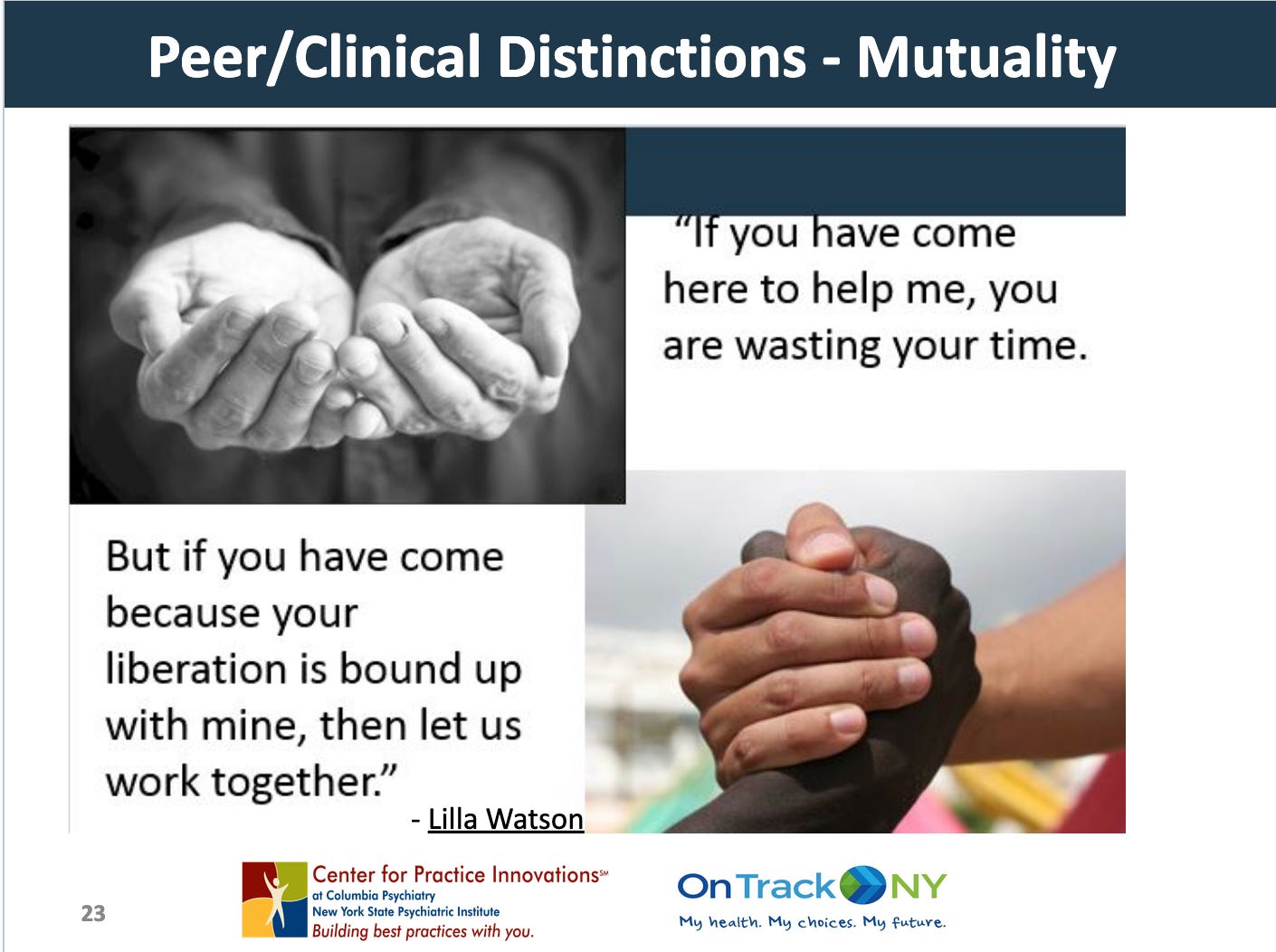
After three years I was burnt out, with not a single hour clocked toward my license, still caught in the same question. Peers can reach people who otherwise can't be reached, but have no power and make no money. Clinicians have legitimacy and a paycheck, but struggle to engage the people I wanted to reach. I sat at my desk at NYSPI and imagined a peer role that was worth as much as a clinical one.

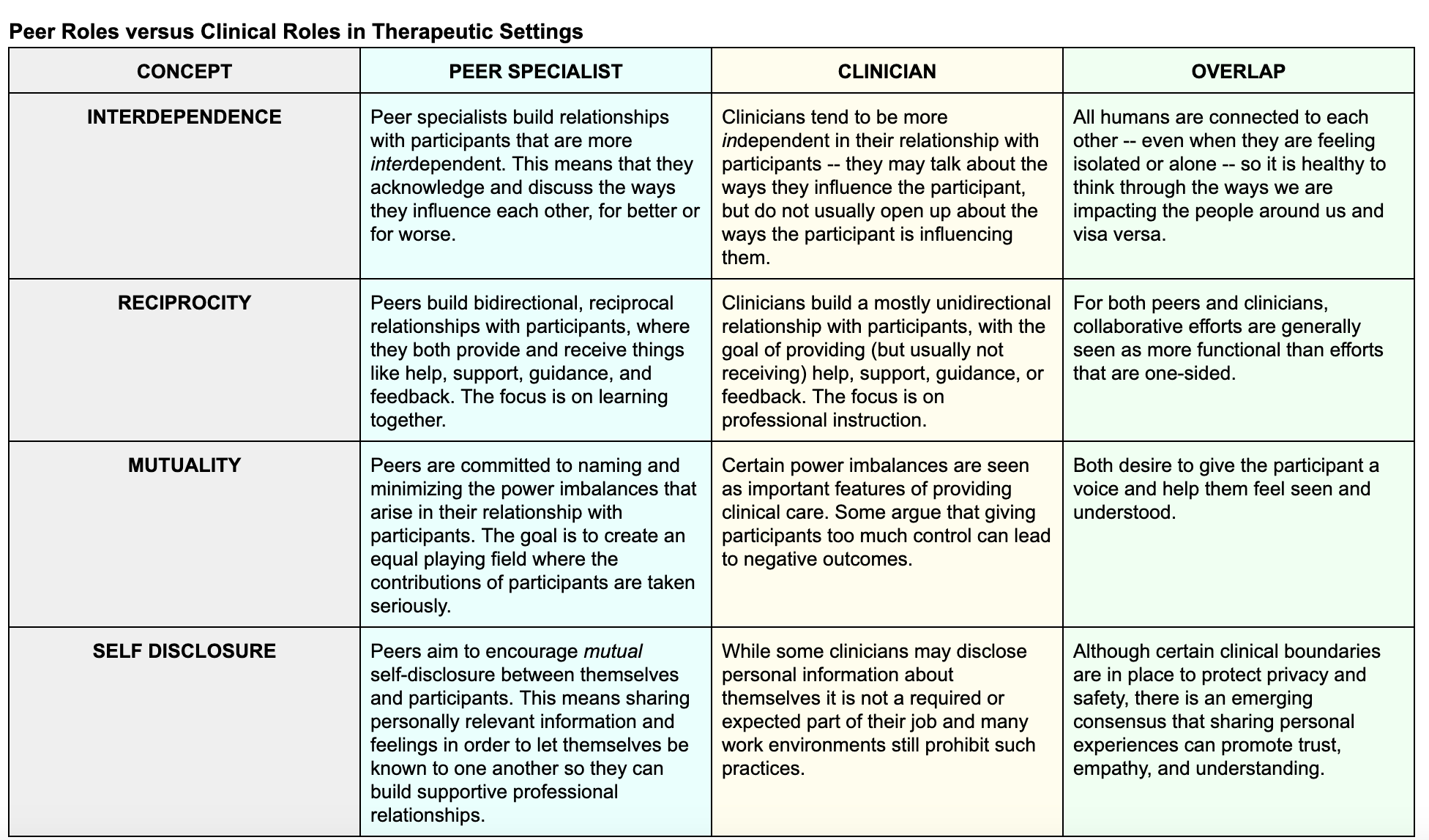
Example of training materials I was developing by the end of my time at OntrackNY (the FEP program I worked on at NYSPI) Text written with Dr. Leigh Kathrine Smith
Internal Family Systems
I found Internal Family Systems therapy at just the right moment, when it was popular enough that I’d heard of it but not so popular that it was impossible to get into a Level 1 training. I devoured that curriculum. Part of it was practical: I could see it was my ticket to the next stage of my life. But the deeper pull was that IFS answered the questions I’d been carrying for years about my role and my identity.
At the heart of the model is the idea that we all have many “parts,” and that our parts have relationships with each other, alliances and standoffs and protection rackets, a whole internal family. And underneath the parts, all of us have a Self that is fundamentally curious, compassionate, creative, and courageous. That’s it. That’s the model.
It’s deceptively simple, and one of the things I love about it is how teachable it is. You don’t have to spend years decoding some esoteric psychoanalytic system written in the archaic language of a century ago. The guy who developed it is still alive, still teaching, and he built it from the same rich systemic family therapy tradition that gave us Open Dialogue. It’s a lineage I already trusted.
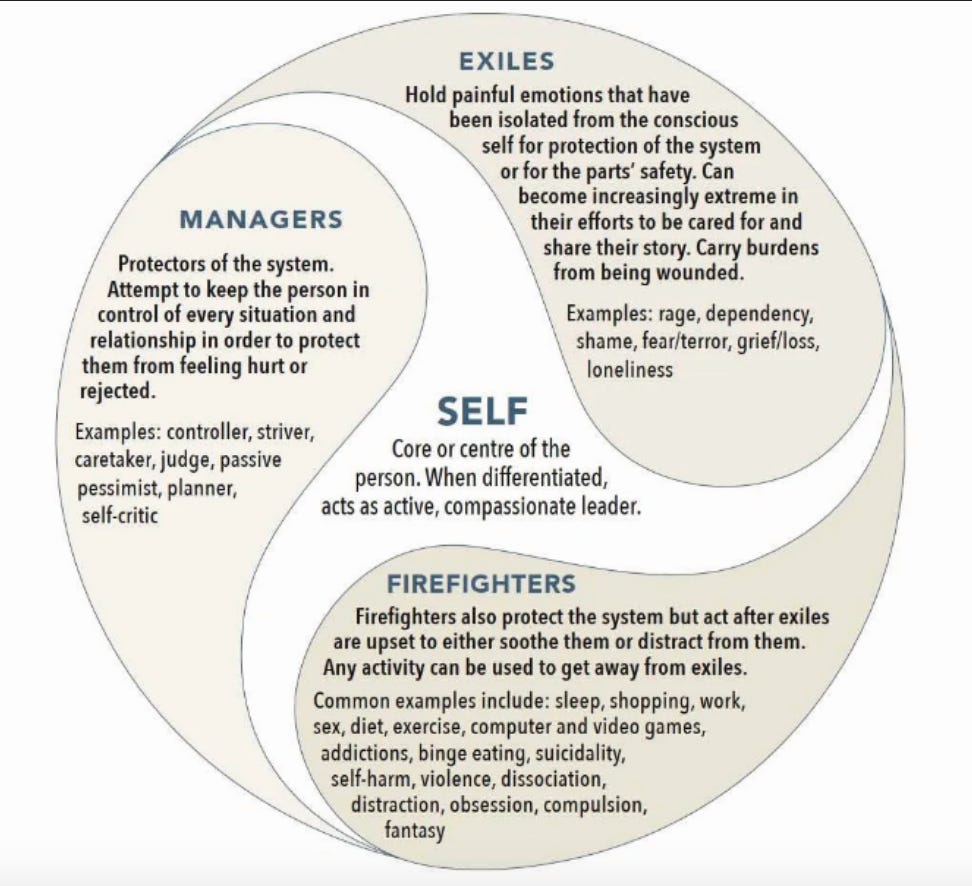
One of the most practical tools in IFS is the distinction between speaking from your parts and speaking for them. When I’m flooded and my scared part has taken over the microphone, I’m speaking from it. When I can say “I have a part that gets scared when you talk about stopping your meds,” I’m speaking for it.
That one move solved a problem I’d been chewing on since Parachute: how to bring my lived experience into the room without either hiding behind a clinical mask or dumping my whole story on someone who came for help with theirs. Speaking for my parts lets me be transparent and boundaried at the same time. It’s self-disclosure with a steering wheel.
And here’s the thing I love most about practicing this way: I’m under no illusion that I’m the one who’s supposed to heal anybody. My job, in the language of IFS, is to be in Self: curious, compassionate, connected, calm, so that the people I sit with can find their own. The healer is already in the room, and it isn’t me.
This is intuitive for anyone who came up through peer support. It’s exactly what we were doing in those Icarus meetings without a name for it. But for people socialized as therapists, trained to be the expert in the room, it can be genuinely destabilizing.
I saw this up close in my Level 1 training, sitting in a room of what felt like mostly middle-aged women therapists retraining in a new model. So many of them had been socialized as caretakers long before they were credentialed as clinicians, and IFS was asking them to put down the very thing that had organized their lives: the job of fixing other people.
Marchiano says:
It can sometimes be helpful for a patient to know something personal about their therapist. The question is always whether such revelations are in service to the patient and the process or in service to the narcissistic needs of the therapist or the defensive needs of the patient.
Notice the assumption buried in that question: that a therapist's needs and a patient's healing are always on opposite sides of the ledger. If I'm honest with myself, of course I have needs in the room. Everyone does. The difference is that I'd rather be honest about mine and put them to work than pretend to be a blank slate my clients can project onto.
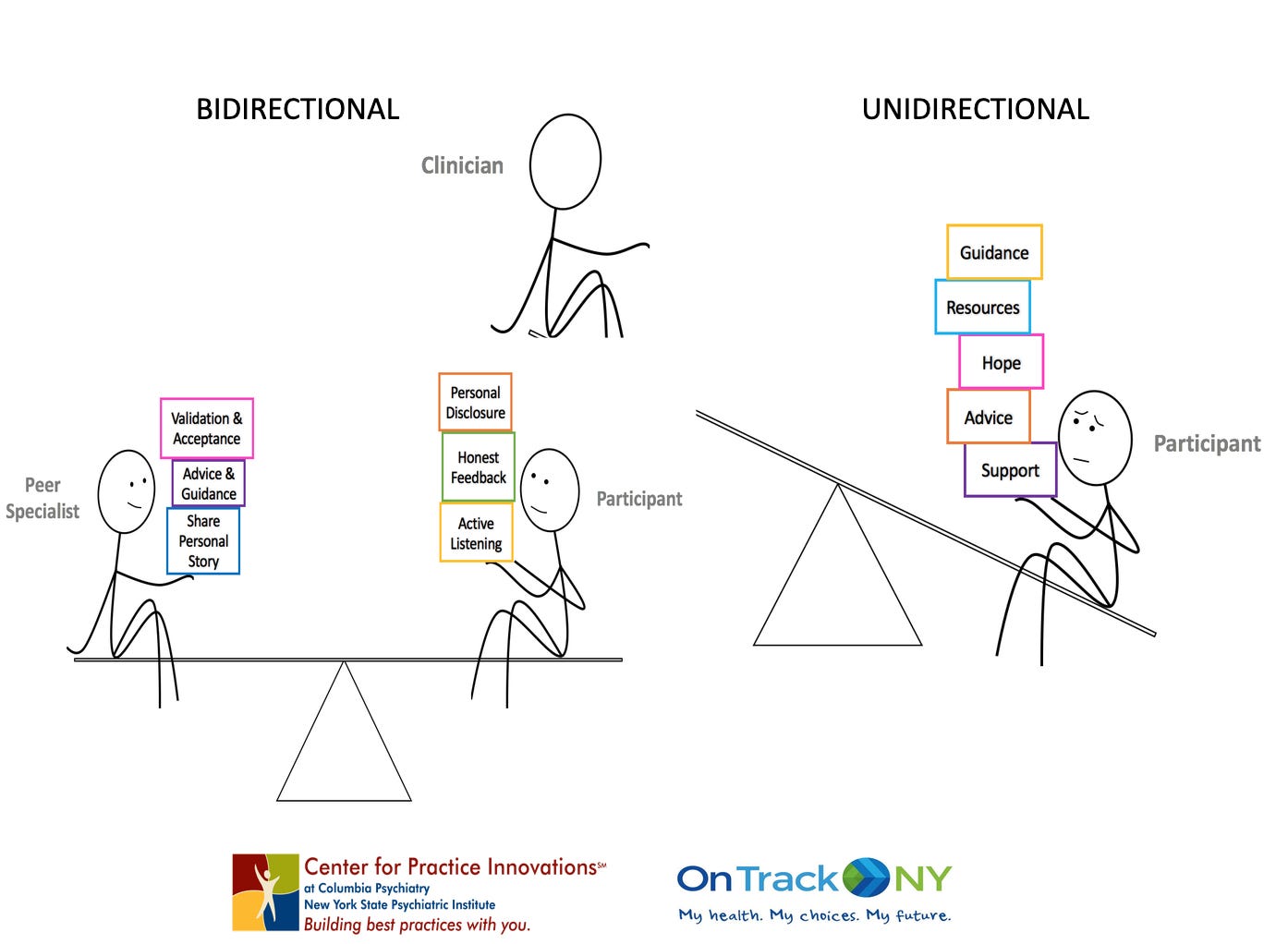
(Bi-Directionality in Peer Work image credit: Dr. Leigh Kathrine Smith)
An Example of the Peer Orientation in Practice (with permission from my client)
Early in my private practice, an exhausted mother reached out to me about her 17-year-old son. He came to our first session already carrying a stack of diagnoses: bipolar disorder, ADHD, something on the autism spectrum, and my favorite, oppositional defiant disorder, which as far as I can tell is the clinical term for a teenager who won’t do what adults tell him. We took an immediate liking to each other. He appreciated that I wasn’t trying to take care of him. I was just genuinely curious about his life, the wild stuff he was exploring on the internet, the way he thought about the world from his middle American hometown. If I had tried to be a blank slate for his projections, I would have lost him in a month.
He was clearly intelligent, but it wasn’t clear he was going to graduate high school. He couldn’t be bothered to show up, and street culture interested him a lot more than academics. About a year in, he was experimenting with drugs and keeping company that worried me. I couldn’t control any of that, and pretending I could would have ended the one thing I did have: a standing appointment with an adult he’d actually talk to. So I showed up, week by week, and kept the channel open. It paid off. One day he called me from his car on the other side of town; he’d run away from home a few days earlier. Of all the adults in his life, I was the one he called. I talked with him for a while, and he decided to go back to his mom’s house. Not long after, he graduated and got a job.
The breakthrough came later, when he was 18, on a day when I was the one having a hard time. My kids had woken me up before dawn, I was fighting with my partner, and I felt half crazy. I’d already seen four clients that day and kept it all to myself. But when he asked me what was going on, some part of me didn’t feel like hiding it from him.
I don’t remember my exact words. What I remember is that I told him the truth: that I was feeling insecure and lonely, that I was angry at myself for the fight, that some days I wondered if I was any good at the life I’d chosen. It didn’t feel like it was in service to my narcissistic needs. It felt like being honest with someone who could use some honesty in his life.
His whole tone changed. Some adult in him showed up, as if my honesty had conjured him. He told me my feelings sounded pretty normal and that I probably needed a good night’s sleep. He knew what it was like to fight with people he loved. As he spoke, I realized what was happening: our relationship was giving him room to be a grown-up, a role nobody else in his life was offering him. I was letting him support me, and it was good for both of us.
I thanked him for being my therapist. We both laughed.
After that session, our conversations changed. He trusted me with more vulnerable territory. I had modeled how to disclose in a healthy way, and he was practicing on me. Mostly he talked, but when he asked how I was, I told him the truth.
What we were building was a kind of genuine mutual relationship he had never had with an adult. This wasn't a technique. I was being a real human being, because that's what the situation called for. I knew the whole time how unorthodox it looked: a middle-aged man telling a supposedly "mentally ill" young person about his hard day and taking his advice. In a clinic, the paperwork has no category for a moment like that, because the paperwork was designed to protect institutions from liability, not to protect a kid's chance at a real relationship with a trustworthy adult. It was the right thing to do and I stand by it.
He’s 22 now. He works full time, he’s in a serious relationship that seems healthy, and he’s building a life. I know I played some small part in him growing up. He played a part in me staying honest.
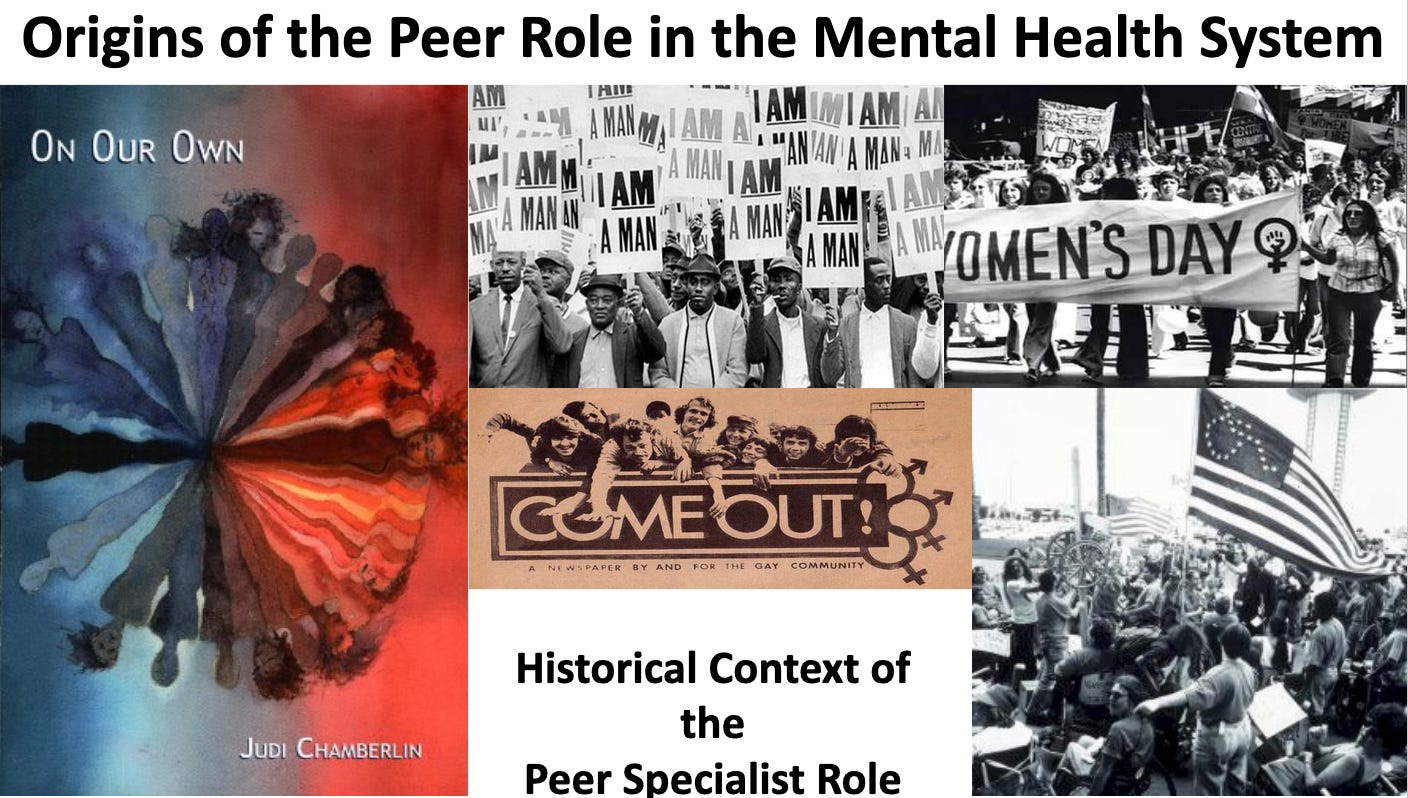
The Illusion of Sameness
Marchiano:
A second issue with therapist self-disclosure… is that it may feed an illusion about what it takes to be known intimately. Announcements about the therapist’s identity, political beliefs, sexual orientation, and psychiatric diagnoses are presumably being offered so that prospective patients can feel assured that this therapist is capable of understanding them because they share key traits in common…Shared life experiences and convictions may mislead both parties into believing that deep empathy and understanding can be assumed, when in fact it cannot.
This is her strongest argument, and I think she’s half right. Shared identity is no guarantee of understanding. Some of the worst misattunement I’ve experienced came from people who assumed they knew me because we checked the same boxes. Empathy has to be built, not assumed.
But notice what she smuggles in: the idea that because sameness can’t guarantee understanding, the therapist should offer nothing at all. That doesn’t follow. In social work school I wrote a paper arguing that modern therapists could learn a lot from clinicians who practice in small towns, where the blank slate has never been an option. Your therapist sees you at the grocery store. She knows your cousin. You watched her kids grow up. Small-town therapists have always had to work with being known, and the profession didn’t collapse. The anonymous therapist is a recent invention of big cities, not a clinical necessity.
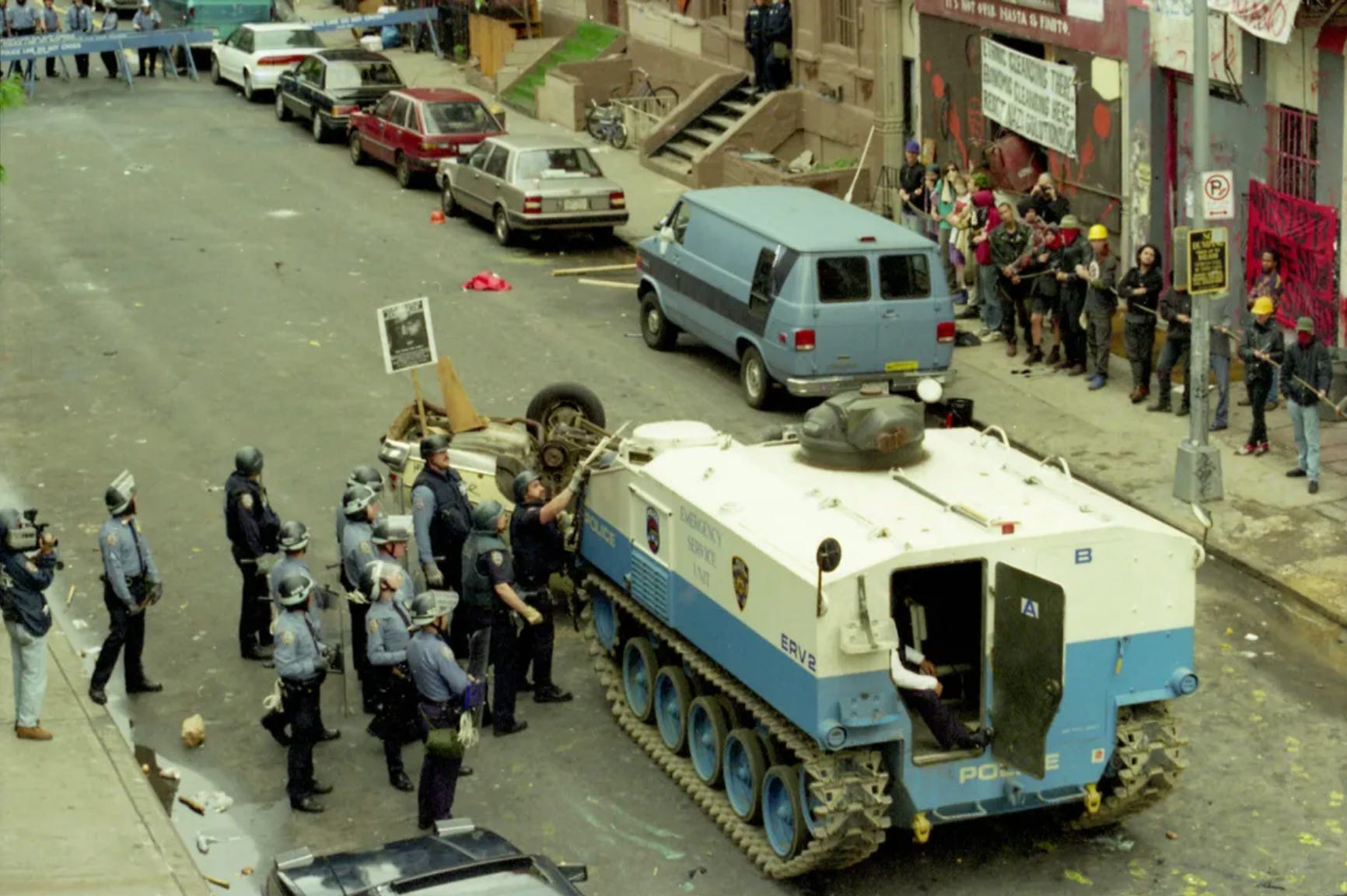
The eviction of the 13th street squats, NYC (1995)
My own weekly therapist is someone I've known since I was a teenager, from the New York City anarchist squatter punk traveler scene we both came of age in. We don’t just share politics; we know the same cast of characters and institutions, living and dead. There’s a lot about my life I never have to explain. When we’re in each other’s cities, we hang out as friends. Sometimes he pisses me off, and I tell him, and we talk about it.
None of that means he automatically understands me. It means that when he doesn’t, we have somewhere to stand while we figure it out.
And it’s hard to imagine feeling comfortable with a therapist pretending to be a blank slate right now. In this fractured and demented political landscape, I can’t imagine not knowing how my therapist feels about masked men snatching people off our streets and putting them in camps, or how he’s holding the economic and environmental disasters unfolding around us. We don’t have to talk about any of that. I just need to know we’re standing in the same world. I’m pretty sure I’m not alone in that.
What I don’t want, because I’ve had it, is a clinician hiding behind professional boundaries and silence who turns out not to understand a word I’m saying and has no idea how to meet me as another human being. No one deserves that.
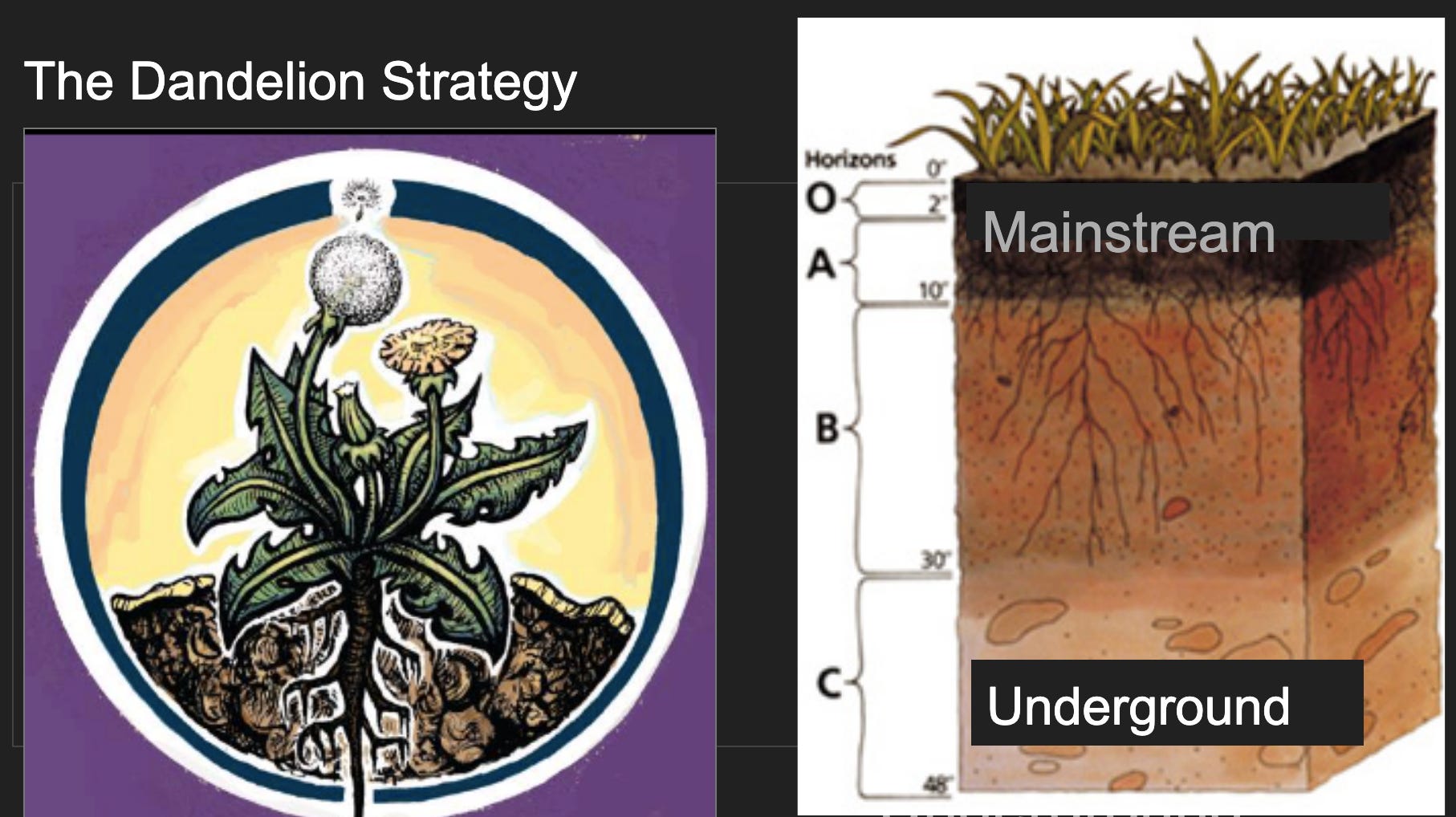
I’m Not Really a Therapist But I Play One on Zoom
It’s been more than six years since I started my private practice, and stepping into this role has been one of the most humbling and gratifying things I’ve ever done. I’ve had to grow enormously to hold space for people in real pain. And I make a living doing it.
If you want to get technical about it, I don't have a clinical license, so my website says "mental health coach." But people pay for my services, and what we do together sure looks like therapy. The people who find me know exactly what they're getting, because my whole life is searchable. That's the thing about being publicly crazy for twenty-five years: I couldn't hide behind a blank slate if I wanted to. Anyone who googles me learns the intense stuff before our first call. What Lisa treats as a liability is my credential.
The practice I’ve built doesn’t look like conventional therapy, and not just because of the disclosure. When it’s appropriate I actively connect my clients to each other. I work from the orientation that people who struggle should practice supporting others who struggle, because that’s where my own healing came from and it’s what twenty years of peer support taught me. I meet with two informal supervisors regularly, and behind them stands a community of dozens of people, some professionals, some not, who I reach out to when I’m wrestling with something in my work. I take the job that seriously. My accountability comes not from a licensing board but from a web of relationships that would notice if I lost my way.
Sometimes I reflect on how I could never have been a traditional clinical therapist. I’d have been no good at it, and I’d have felt like an impostor every day. The strange truth is that the unlicensed role is the one where I’ve never felt like a fraud. It forces me to be genuine. There’s no protocol to hide behind, so I never work with two people the same way. There’s just me, my experience, my community, and the person in front of me.
Which brings me back to a question I’ve been carrying since my days at NYSPI: what makes someone a professional? I used to sit at my desk there and imagine a peer role that was worth as much as a clinical one. It turns out I couldn’t build it inside the system, so I built it in my own practice. But a role that only works for one charismatic weirdo with a movement behind him is just an exception with good branding.
So the obvious next move is to start training people. The thing I do is teachable, the same way IFS is teachable: not an esoteric art but a set of practices. Speaking for your parts instead of from them. Disclosure with a steering wheel. Accountability through community instead of credentials. Connecting the people you serve to each other. None of this requires a license. It requires lived experience, real training, and a web of relationships to hold you honest. Peer supporters fought their way into the public mental health system and got handed clipboards and poverty wages. I want the version we were actually fighting for: a role with its own lineage, its own rigor, and its own worth. Not a cheaper copy of a clinician. Something clinicians can’t be.
Lisa Marchiano is right that the therapist’s chair holds real power, and that self-revelation can serve the wrong master. Where she’s wrong is in thinking the answer is to hide. For some of us the answer is to be so thoroughly known that there’s nothing left to hide, and then to do the work anyway, as one human being with another. That’s not the death of the profession. For those of us the profession never fit, it might be the beginning of one.
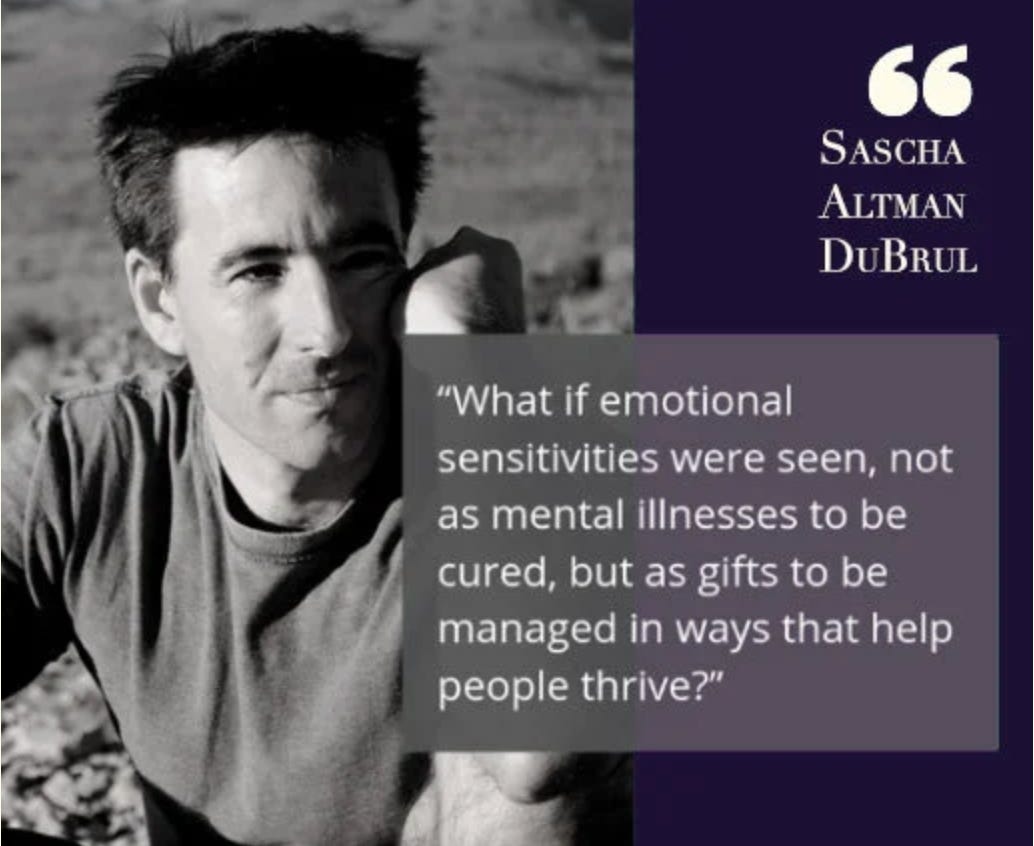
If you’re interested in talking to me about any of this stuff, be in touch. My door is open.
Check out this video where I have a conversation with some very smart people about a very interesting topic:


I'm someone with lived experience of mental distress who has practiced peer support in community and would one day like to become sometime who helps people more formally. I've also experienced therapy from people with different backgrounds and noticed the way the most human one has made the most difference to me.
I'm most curious about the way you describe the support you have for yourself in your private practice, the web of people around you. Was it something that grew organically? Could the creating of it be taught alongside the practice of what you do? (I'm wondering because it feels like the most necessary part of sustaining / nourishing a care practice, and your words reflect that compared to clinical descriptions of supervision)
Well, I'm a clinician who uses a lot of self-disclosure with my clients. I am a licensed clinical social worker who was misdiagnosed with various forms of schizophrenia and experienced 15 involuntary ECTs at age 17 in 1964. I got my MSW in 1976 and have worked at many social service organizations since then. I received my clinical supervision for licensure as a social worker in the mid-1980s while working as an Outclient Therapist at Elahan Center for Mental Health and Family Living in Vancouver, Washington.
I have always had a private practice. I was licensed as a clinical social worker in Oregon and now Hawaii. I also don't do well with clinicians who want clients to talk to a blank slate and don't share anything about themselves.
I value peer counseling and life coaching. I completed a certification program in life coaching from Coach U in 2003.
Many times when applying for work at social service organizations I told them in my interviews about my psychiatric history. I usually told my clients about my own lived experience as an electroshock and institution survivor. When I moved back to Maui in 2007 I decided to be more selective about which clients I told about my own psych history to see what that was like. What I discovered is that when I later revealed my own lived experience as a mental patient I began struggling with internalized shame more than I ever had before. I became hyper aware of the stigma attached to having been diagnosed as a mental patient especially at times when getting medical care as an older adult. That's why the title of my memoir, OUT FROM HIDING, fits my life experience so well.